
Phantom Power Music · Nashville, Tennessee · Est. 2020
We're not a music company
We're musicians who got tired of the math
Phantom Power Music began in 2020, when a group of musicians started writing about music during the pandemic. What started as a blog has since evolved into a public benefit organization with a much bigger mission: protecting human-made music from the growing threats of AI and the slow death of streaming economics.
Our objective is simple but urgent: build free tools that help artists take control of their own financial destiny.
In 2025, Phantom Power Music evolved into the Epoch Music App — a Bitcoin-native, Lightning-powered monetization platform that enables artists to get paid instantly and globally by their fans. More than a product, Epoch represents a new publishing model: one designed to remove middlemen and restore a direct relationship between artists and audiences.
Through the Epoch Music App, our Bitcoin-native Lightning platform, and the #cancelspotify movement, we are working to dismantle extractive streaming models and replace them with direct-to-fan value exchange — one where artists are paid first, not last, and independent musicians regain control over their creative and financial future.
THE REAL NUMBERS
This statement - or one just like it - landed in someone’s inbox today. Maybe yours.
For most artists, it arrives as a maze of spreadsheets, royalty reports, and thousands of lines of data spread across 20 different statements, platforms, collection societies, and payment systems. Every month, artists are expected to somehow decode it all, reconcile it, and understand how their life’s work is being translated into income.
But when you actually crunch the numbers, the result is alarming.
What looks complex on the surface resolves into a much simpler truth: massive usage, microscopic payouts, and a system designed to make it nearly impossible for artists to clearly see where their money comes from, where it goes, and why so little of it reaches them. This is not just an accounting problem. It is a structural one. For decades, musicians have been forced to navigate a fragmented industry where revenue is split across streaming platforms, performance royalties, mechanical royalties, social platforms, video platforms, distributors, publishers, PROs, and collection agencies - each with its own reporting format, payment timeline and opacity. The result is confusion by design. And yet, the final number is always brutally clear.
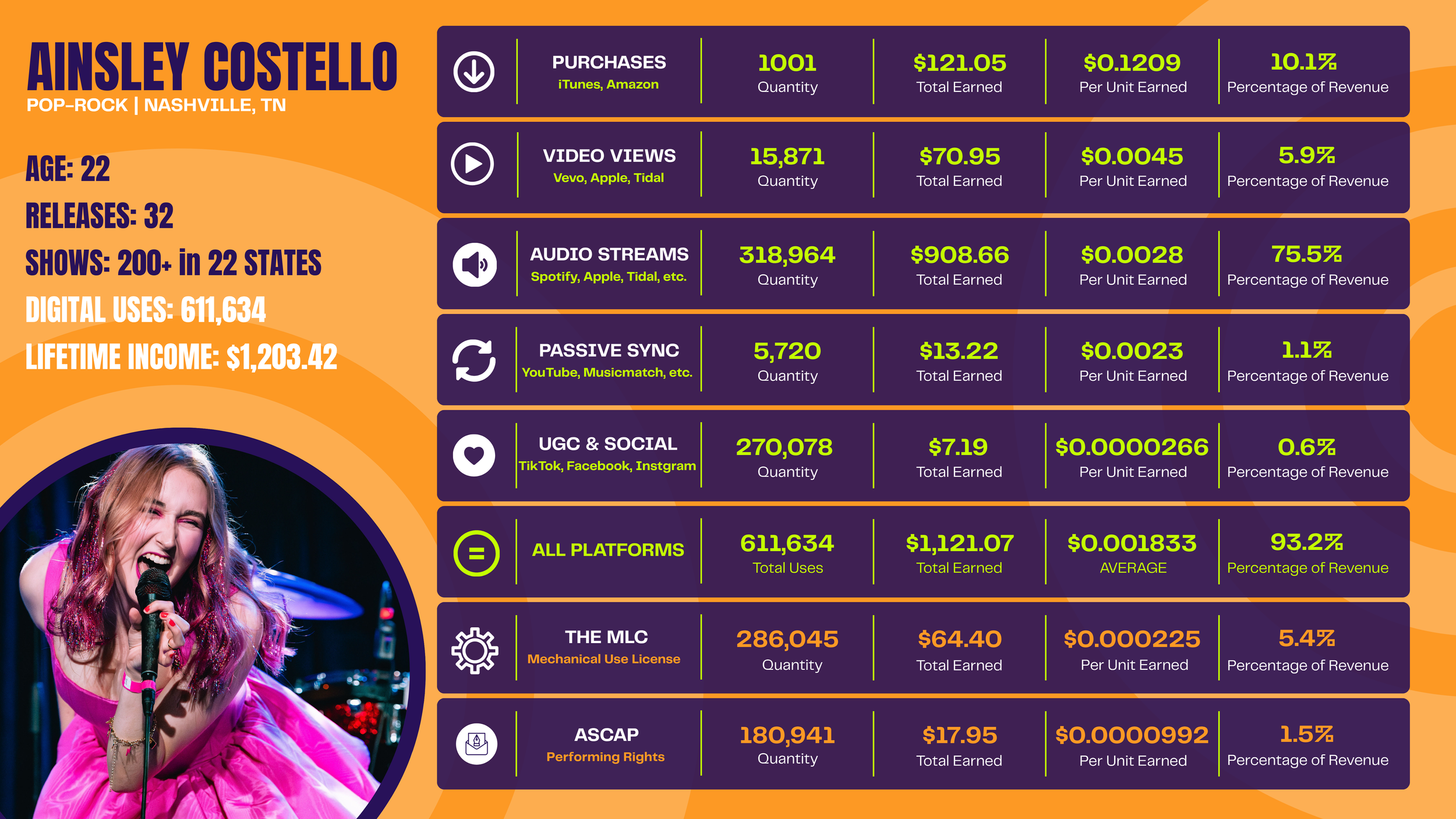
Thousands of uses. Thousands of fans reached. Years of work. Almost no meaningful income.
That is the crisis.
The modern music economy has normalized a system where artists generate enormous cultural value while receiving earnings so small, so delayed, and so fragmented that even understanding them requires expertise most working musicians do not have the time or resources to develop.
These numbers are not just disappointing. They are a warning.
Human-made music is being undervalued at scale. Artists are being buried in data while being starved of income. And unless the economics change, the future of music will belong less and less to the humans who create it.
**Ainsley’s music was used 611,634 times and paid $1,203 total - over 6 years. If every use returned just $1, that’s over $611K. Imagine any other business being told that’s acceptable. No baker sells it’s bread for less than it costs to make. This would be unacceptable in any other industry.
If you care about the future of real music
Join us
Whether you have a question, an idea, or just want to get involved, feel free to reach out —we’re looking for artists around the world to join the fight. Form a chapter, spread the word.